A specialty coffee brand running its own B2C and B2B operation. In three phases we took their tech team from a manual development process to an agent-driven workflow, and the technical debt now gets cleared without a project of its own.
- incapto.com
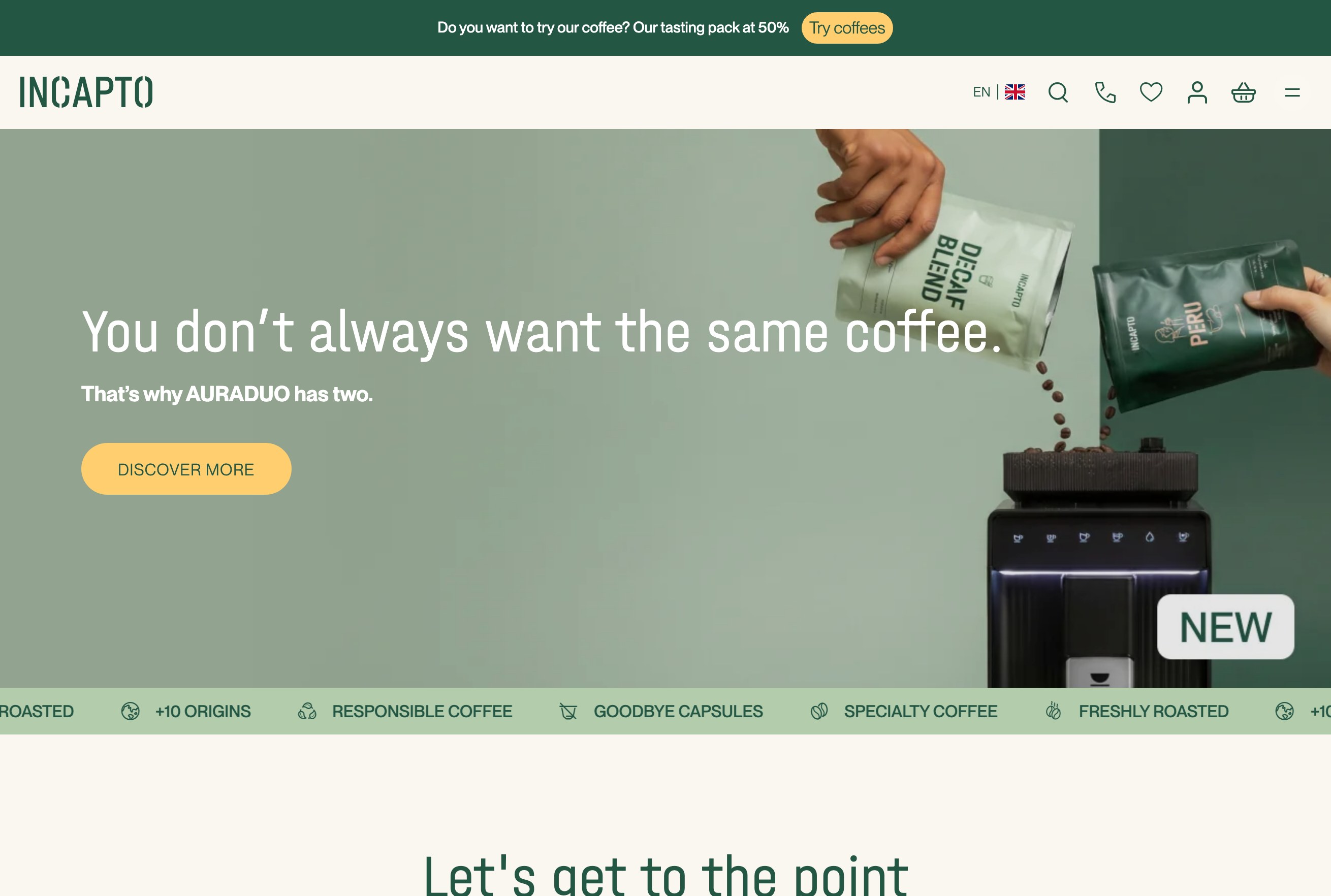 9:41●●●●🔒www.incapto.com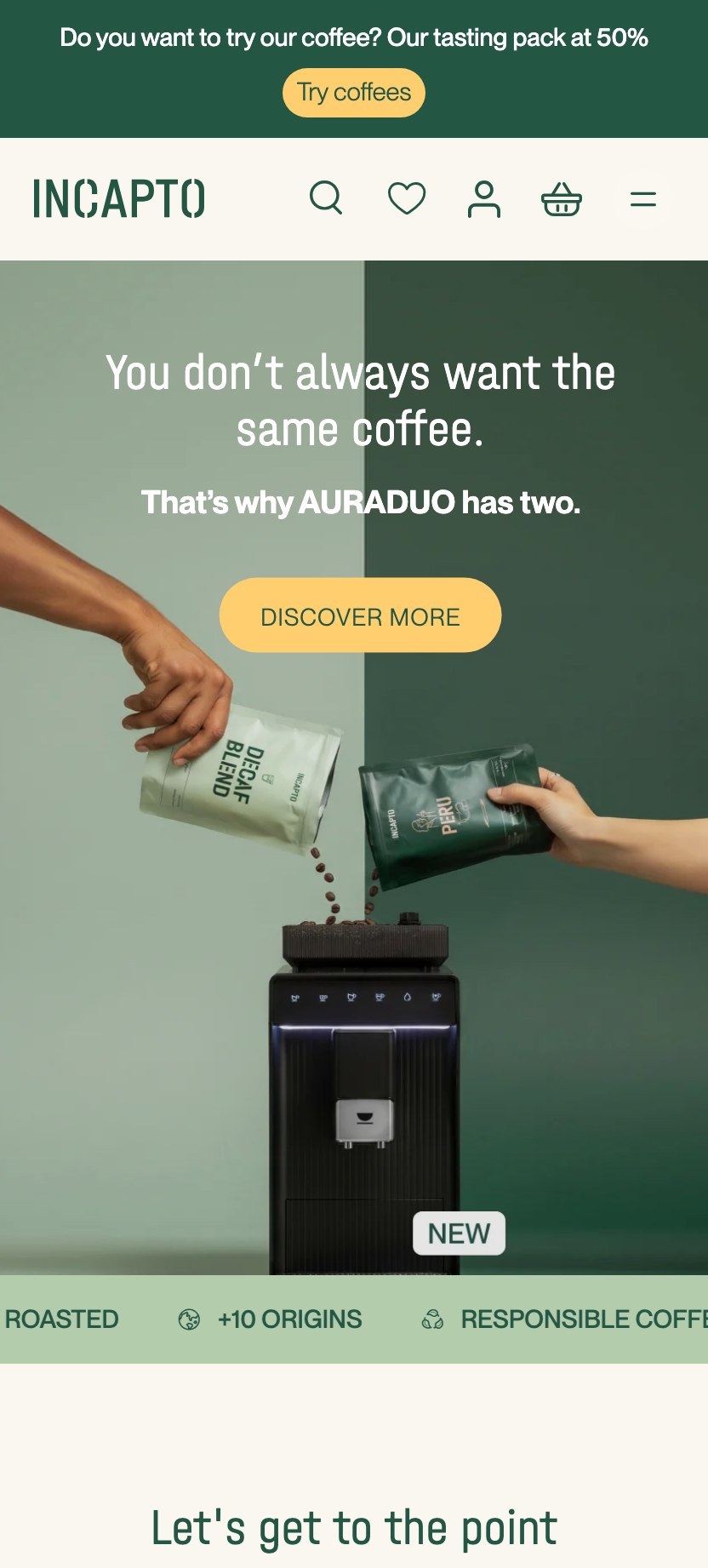
Incapto is the specialty coffee brand, beans and bean-to-cup machines, born to put an end to capsules.
The challenge
A business in constant growth, with a small and very efficient tech team and challenges ahead:
- Many repositories with years of evolution, between active and legacy systems, all managed through git flow.
- Their own ERP sitting as middleware between the sales channels and the back office.
- A manual development process: the backlog grew faster than the team could consume it, and tasks arrived under-specified.
- Technical debt across the legacy systems that never found a window to be resolved.
What we did
- 01
Phase 1 · Discovery, stack and foundations
A discovery session with the people who decide on product and on technology, an analysis of the B2B platform and its stack, and a backlog with the first automation targets. Two decisions came out of it, and everything else rests on them.
Git flow → trunk-based development
Less friction: from maintaining several repositories and several branches to a single repository with a single branch.
Working Agreements
Written down, not implied: how a task is defined, how it is reviewed and how it reaches production, the same way on every project.
- 02
Phase 2 · Analysis, configuration and the first workflow
We analysed the architecture, prepared the repositories with their AI configuration and wired them to the management and CI/CD tools. The phase closed with the first working version of the operational workflow.
Repositories that explain themselves
AGENTS.md and CLAUDE.md in each project, plus configuration for Claude Code, Codex and Gemini, so any agent can be put to work without a briefing.
Claude Code connected to ClickUp
A connection over MCP that closes the loop: the spec is generated from an idea and the task lands on the board ready to work on.
Reusable skills
commit, issue-create and issue-work: three skills that tie the AI workflow to version control and the task board.
Review and release, automated
A GitHub Action reviews every pull request, and conventional commits decide the version: fix, feat or breaking.
- 03
Phase 3 · End-to-end implementation and autonomy
The full cycle running on the team's own work: create the task, plan mode, execution, review, and deployment to staging and production. And the part that makes it last, which is handing over the judgement rather than the tool.
A real task, start to finish
We took a task already sitting in the ClickUp backlog and shipped it with Claude Code, live, with the team watching.
Technical debt inside the flow
The B2B repository went from Laravel 8 to Laravel 12 in a single pass, with Rector, without opening a project of its own.
Documentation as a single source
A pragmatic documentation process on Google Workspace, and a CLI to pull the content back out: the groundwork for a company knowledge agent.
The change is in the process: the team stops translating between the idea and the code, and technical debt gets cleared inside the flow instead of waiting for a project of its own.
Workflow
- 01Idea
- 02AI spec
- 03Task in ClickUp
- 04Branch
- 05Plan mode
- 06Agent-driven development
- 07Conventional commit
- 08Pull request
- 09AI review
- 10Staging
- 11Production
How we work: what a forward deployed engineer (FDE) is and why it matters →
You helped us make the change actually happen: putting agentic systems to work at Incapto. Seeing it in a demo is one thing; doing it for real, shipping features without stopping the machine, is another. We now have a far more productive team, and it is the spearhead for taking AI to the rest of the company.

Milestones we worked on
Agent-driven development
The whole tech team works with Claude Code across every active project.
Projects ready for AI
AGENTS.md, CLAUDE.md and configuration for Claude Code, Codex and Gemini.
Automated pipeline
AI review on every pull request, conventional commits and automatic tagging through GitHub Actions.
A team that owns it
Skills, working agreements and mentoring, so the workflow is kept by the team and not by us.
This case shows how we take a tech team to working with agents without stopping delivery: first understand the real process, then shared foundations, and on top a flow where the AI does the work and people decide.
Let's talk about your case
Does any of this sound familiar? We'd be glad to help!
Let's talk← All clients