
Medicine took centuries to split into orthopaedic surgeons, cardiologists and paediatricians. Software is much younger, and in its fifty years of life we can probably only talk about real professionalisation over the last decade. Even so, today we no longer talk about “programmers”, but about specialists by discipline, and even by programming language.
Backend or frontend. Data scientist, DevOps, QA or mobile. And within each discipline, finer still: Senior PHP Developer, Python Expert, Senior React Developer, Senior Ruby on Rails Engineer, Golang Backend Engineer. Titles we have watched fill LinkedIn for years.
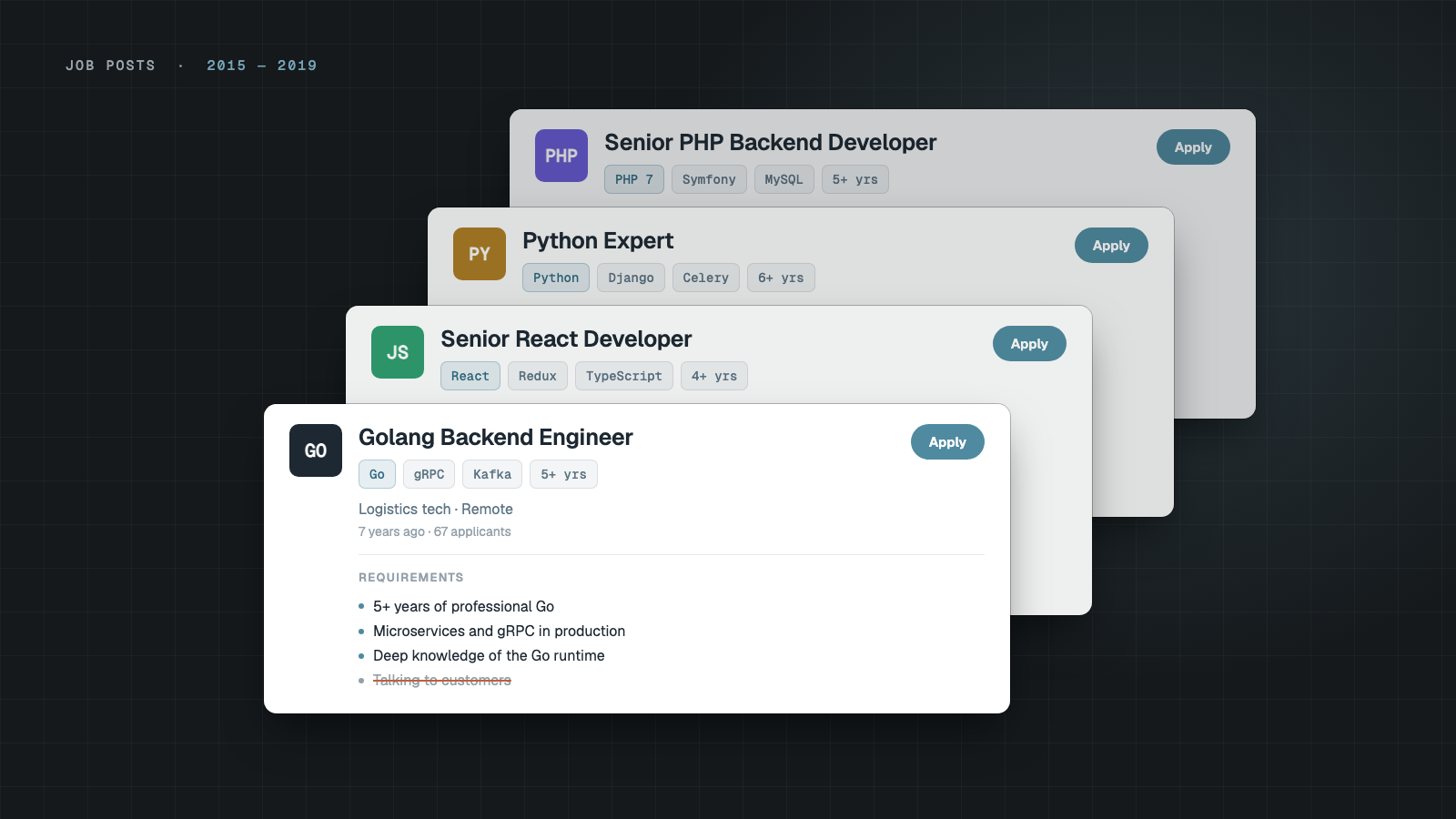
First we need to understand why this specialisation happened, and give it the credit it deserves. Today everything is software. We can all picture the engineering teams at Amazon, Google or Netflix, but the same goes for tech startups, where most of the headcount usually sits in the tech team. That’s because taking a complex product to production needs specialists in every discipline, and often people who are very good at one particular language.
Well, over the last year and a half all of that has changed completely. For the last few decades we trained to be the “knee” specialists of software, and now we have done a rollback to the family doctor, the generalist: the programmer who did everything, as we used to say.
With one small difference: systems are not only still complex, they have more dependencies, more actors than ever interacting with them, and the complexity of software has never stopped growing.
And the specialists? They are AI agents now.
What it cost us without us noticing
Thursday afternoon. The feature is ready, the development done, but the colleague who was supposed to do the code review has already left for the day. Friday we have a no deploy on Friday policy, so it’ll go out on Monday. On Monday a new emergency comes up, and the feature slips to Tuesday.
Sound familiar? It’s a headache and a hole in the company’s pocket: every day that passes is lost opportunity cost.
Companies with bigger budgets can afford more diversified teams and reduce those dependencies that way. They hire a second specialist in the same language, sometimes not for the volume of work, but to guarantee delivery. Multiply that by every language and every layer, and a good part of a tech team exists to cover for itself.
And what happens when the budget is tighter and there’s only one person per discipline? If the backend person is on holiday, the backend doesn’t move.
Then there are the hand-offs. Backend finishes, frontend picks it up, QA tests it, ops deploys it. Every hand-off is a queue. Every queue, a few days nobody planned for.
And the biggest cost: what happens once it has been delivered to the customer. Are we close to the business? Do we see whether that feature had an impact or not? Usually, when a tech team delivers a task, it moves on to the next one. And that’s where there’s a clear misalignment between what gets delivered and what the customer actually wants.
What changed
Now one engineer can do what used to take a team of specialists. Not because they know everything, but because they direct agents that do.
In August 2025, Thomas Dohmke, then CEO of GitHub, explained that the developers who use AI the most have moved from writing code to delegating and verifying it.
In February 2026, Spotify’s co-CEO said its best developers hadn’t written a single line of code since December. They describe the change, an agent makes it, they review it and ship it. Sometimes from their phone, on the way to work.
In August 2026, Uber reported that more than 70% of its pull requests are attributed to agents, with people reviewing and approving them.
These aren’t startups chasing a trend. They are very demanding engineering teams, and they all describe the same thing: the job is no longer typing code.
The specialists are now the agents
Here’s the uncomfortable part: knowing Python is no longer a career.
An agent writes Python, Rust, PHP or TypeScript. It knows the framework you learned last year and the one you never will. It doesn’t distinguish between backend and frontend, because for it that boundary doesn’t exist.
Kent Beck said it before it was obvious: 90% of his skills had just gone to zero, and the other 10% were worth 1000x more. That 10% is not a language. It’s knowing what to build and judging whether the result is good.
But an agent is only precise if it’s narrow. It needs a clear domain, just the right context and a way to check its own work. Ask it to “help with the backend” and you get confident mediocrity. Ask it to “reconcile supplier invoices against the ERP and never post anything above €5,000” and you get a tool you can trust.
Someone has to define that domain. Someone has to decide which agents are needed and what they must never do. That’s the new job.
The agents are the specialists. The humans are the generalists who design them.
What a generalist does
It doesn’t mean knowing a bit of everything. It means owning an outcome, from the customer’s problem to a change in production, and back again.
- Understands the problem by talking to the people who have it.
- Splits it into what an agent can do and what a person must do.
- Defines the agents: domain, context, limits.
- Reviews what comes back. This is where depth still counts: not in syntax, in judgement.
- Puts it in production and watches what happens.
Some companies were already hiring this way before AI. PostHog calls it a product engineer: one person who takes a feature from idea to user feedback. They talk to users, ship and start again. Without handing it to another team.
And the metric changes. Story points and lines of code don’t count. What counts is the time between a customer’s problem and a change they can use. The team that closes that loop in days beats the one that closes it in months, whatever its language.
Before you fire anyone
This isn’t about “AI replaces engineers”. Two caveats.
Tools alone don’t make you faster. In early 2025, a METR study found experienced developers were 19% slower with AI, even though they believed they were faster. A year later, when METR tried to repeat the study, many no longer wanted to work without AI. Speed doesn’t come from the tool. It comes from changing how the work is organised.
And a generalist without judgement is worse than a specialist. If you can’t tell good code from code that only looks good, the agent will help you get it wrong faster.
What to do on Monday
If you run a company: stop hiring by language. Organise teams around an outcome for the customer. Measure how long a problem takes to reach production, solved. And before you hire a second specialist just in case, ask yourself whether what you need is a well-defined agent and a person who owns it.
If you’re an engineer: get closer to the product. Learn the business you work in. Learn to give an agent a brief it can’t misread, and review what it hands back as if your name were on it. Because it is.
For twenty years the industry rewarded whoever went deepest into a single specialism. Now it will reward whoever sees the whole.
That’s also the work we do with our clients: a forward deployed engineer joins the team, learns the business and takes AI workflows all the way to production.